
There are moments that permanently change the way you see the world.
For us, the years surrounding the pandemic were one of those moments.
Communities were navigating a global health crisis. Institutions were adapting in real time. New partnerships were forming almost overnight as organizations worked together to meet urgent needs. It became increasingly clear that no single institution, sector, or community could respond to challenges of that magnitude alone.
At the same time, conversations about racial equity, economic justice, public trust, and institutional accountability were unfolding across the country. Organizations were asking difficult questions about their role in creating lasting change, while communities were challenging long-held assumptions about how systems function and who they ultimately serve.
Looking back, those years did more than expose weaknesses within individual organizations … They revealed how deeply interconnected our institutions really are.
They also challenged many of the assumptions that had long shaped how organizations approached change. For years, the prevailing belief had often been that if individual institutions became stronger, more efficient, or more strategic, broader systems would naturally improve as a result. Strengthening organizations remains essential, but those years revealed that institutional strength alone is rarely enough to address challenges that extend beyond organizational boundaries.
As organizations worked to adapt, another pattern began to emerge. Progress often depended not only on what was happening within an institution, but on how effectively institutions worked together. Relationships between partners, governance structures that supported shared decision-making, mechanisms for coordination, and the ability to align around common goals became just as important as the work happening inside any one organization.
In other words, lasting change required strengthening both the institutions themselves and the connective tissue between them.
Housing affects workforce participation. Workforce systems influence economic mobility. Health outcomes are shaped by transportation, education, housing, employment, and public policy. The same interconnected thinking also applies to community engagement for neighborhoods and public safety, where lasting outcomes depend on coordinated action rather than isolated efforts.
The challenges weren’t operating in isolation, so neither could the solutions.
That realization has continued to shape how we think about organizational change, systems design, and the work we do alongside our partners today.
Change Is Networked
Early conversations that shaped The Intersect often centered around a simple but profound idea shared by many futurists: the future is networked.
The phrase has stayed with us over the years because it fundamentally changes how we understand change itself.
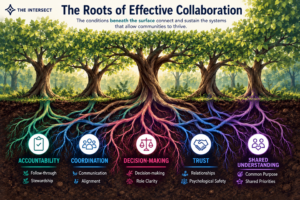
A forest portrays this concept beautifully.
Walking through a forest, it is easy to focus on the individual trees. Some are taller than others. Some appear stronger. Some seem to stand entirely on their own.
Yet beneath the surface, an entirely different reality exists.
Trees are connected through intricate root systems that share nutrients, communicate distress, adapt together, and depend upon one another in ways that aren’t present to the eye.
The health of the forest is not determined by any single tree and the life of each tree is dependent on the relationships between them.
Organizations function in much the same way. Whether the work focuses on government, philanthropy, business, or nonprofit systems change, lasting impact depends on understanding the relationships between institutions rather than viewing them in isolation.
Individual organizations matter, but they do not operate independently of the broader systems surrounding them. They exist within networks of partners, funders, public agencies, community organizations, policymakers, and institutions that continuously influence one another.
When one part of that network shifts, others inevitably respond.
This is why so many of today’s most significant challenges resist isolated solutions.
They are networked challenges. Therefore, they require networked approaches.
But a networked approach is not simply an invitation for more organizations to collaborate, given that institutions huddling around a shared challenge does not automatically create the capacity to address it efficiently.
The way those institutions work together is the differentiator.
Partners need structures that clarify how decisions are made, where responsibility sits, how accountability is shared, and how coordination happens across different roles, priorities, and institutional realities. Without those mechanisms, even deeply committed partnerships find themselves working parallel to one another rather than truly working together.
The Work Between Organizations
One of the observations that has become increasingly clear through our work is that meaningful change is rarely limited by a lack of ideas, but by the absence of the conditions that allow organizations to move together.
Organizations may share similar goals while operating under entirely different incentives. They may agree on desired outcomes while relying on different governance structures, decision-making processes, funding mechanisms, and measures of success.
On paper, everyone is moving toward the same destination, Yet in practice, they are often moving in parallel rather than moving together.
This is where much of our work lives.
We often describe it as strengthening the connective tissue between organizations, institutions, and ecosystems.
That connective tissue isn’t a single framework or process.
It is built through governance that clarifies decision-making, trust that allows organizations to navigate uncertainty together, shared understanding that aligns priorities, accountability that sustains momentum, and coordination that transforms individual efforts into collective action.
These elements rarely receive the same attention as strategic plans or public initiatives.
Yet they frequently determine whether change can endure.
What Networked Change Looks Like
One example of this philosophy in practice is our work with the Detroit Economic Justice Coalition, a coalition for economic justice that brought together leaders across sectors to advance shared priorities.
Detroit launched a first-of-its-kind economic justice table that brought together leaders from workforce, human services, advocacy, grassroots organizing, research, policy, philanthropy, and employer communities.
The coalition was formed around a shared commitment to advancing economic justice.
The opportunity was so much more than simply bringing organizations together … It was creating the structures that would allow those organizations to function as a coordinated network over time.
Together, we worked with coalition partners to clarify the coalition’s purpose within the broader economic justice ecosystem, design governance and decision-making structures, establish shared commitments, build feedback loops that supported authentic engagement, and develop the foundational infrastructure needed to sustain coordination, learning, advocacy, and community-driven policy.
The work reinforced something we continue to observe across organizations, partnerships, and public systems.
Networks do not become effective because people care about the same issues. They become effective because the relationships, structures, governance, and shared accountability needed to move together have been intentionally designed.
That distinction matters.
Because meaningful collaboration involves not only active participation, but also creating the conditions that allow collective action to endure.
Seeing Systems Differently
One of the greatest shifts in our thinking over the past five years has been learning to look beyond individual organizations and ask different questions.
Rather than asking whether one institution has the right strategy, we find ourselves asking how that institution is connected to the broader system around it.
- What relationships shape its ability to create change?
- Where are coordination and decision-making breaking down?
- What assumptions exist between partners that have never been made explicit?
- Where does governance support collaboration, and where does it unintentionally create barriers?
These questions rarely produce quick answers, but they often reveal opportunities that are difficult to see when organizations examine themselves in isolation.
This perspective has become foundational to how we approach our work.
Whether we are partnering with a single institution, a cross-sector coalition, or a statewide initiative, we are continually looking beyond the visible work to better understand the relationships, structures, and dynamics that influence it.
Because the challenges organizations are navigating today go beyond organizational boundaries. Increasingly, neither does the work required to address them.