
Many years ago, before The Intersect existed, a question kept surfacing in conversation after conversation.
Why do so many well-intentioned efforts struggle to create lasting change?
At the time, the question emerged while observing coalitions, partnerships, and initiatives designed to address complex challenges. On paper, much of the work looked promising. Talented leaders were involved, significant resources had been invested, and organizations were united by a common goal.
Yet too often, the work struggled to endure. As relationships became strained, leadership changed, and funding cycles ended, momentum stalled.
What began as transformational became transactional.
Over the years, we have come to realize that this dynamic is not unique to collaborative or ecosystem work. We see it across organizations, public systems, boards, partnerships, and institutions of every kind.
- A strategic plan is developed but implementation stalls.
- A coalition launches with enthusiasm but struggles to sustain participation.
- A new leader arrives and priorities shift.
- An organization identifies the right direction but cannot build the internal alignment necessary to move forward.
The pattern is remarkably consistent, which unearths a steadfast truth: the conditions necessary to sustain change were missing to begin with.
Consider the challenge of connecting housing stability and workforce participation.
Neither issue exists in isolation.
Housing systems, workforce systems, human services, policy environments, data systems, funding structures, and participant experiences all influence one another.
Although these systems often shared complementary goals, they frequently operated through separate structures, funding systems priorities and decision making processes.
This is often how quality work gets stuck.
Not because organizations lack commitment, but because the conditions required for coordination, learning, and shared ownership have not been intentionally designed.
The Difference Between Activity and Change
When organizations encounter urgent challenges, the natural response is to act by launching programs, creating initiatives, forming committees and developing new strategies.
These actions often serve the important purpose of addressing immediate needs and creating momentum around a shared objective. However, activity and transformation are not the same thing.
Many efforts focus on responding to a challenge without addressing the conditions that produced the challenge in the first place. As a result, progress becomes difficult to sustain.
When conditions change, leadership transitions occur, funding shifts, or competing priorities emerge, the work begins to lose momentum since the structures needed to support long-term change were never fully established.
The challenge is not simply generating action … It is creating the conditions that allow action to become tangible impact.
The Work Beneath the Work
One of the most common assumptions in change efforts is that shared goals naturally produce shared action.
In practice, that is rarely the case.
Organizations may agree on the destination while operating with different incentives, decision-making structures, capacities, and definitions of success. The result is often a group of highly committed partners moving in parallel rather than moving together.
This reality became particularly visible during the Home Illinois Workforce Pilot Project, a first-of-its-kind effort designed to connect housing stability and workforce pathways across Illinois.
The initiative brought together partners across housing, workforce, and human service systems, all committed to supporting individuals facing systemic barriers. Yet the success of the effort depended on far more than a shared vision.
It required creating the structures that allow collaboration to function over time:
- Alignment
- Communication
- Coordination
- Governance
- Decision-making
- Accountability.
- Shared ownership
- Trust
These elements rarely appear in headlines, annual reports, or strategic plans, yet they often determine whether an effort succeeds or struggles.
In the Home Illinois Workforce Pilot Project, this meant aligning partners around a shared vision, strengthening cross-agency coordination, establishing a cross-sector Community of Practice, and creating learning structures capable of capturing participant experiences and informing program adaptation.
None of these efforts were secondary to the work.
They were the work.
Because lasting change depends not only on what organizations are trying to accomplish, but on whether the relationships, structures, and systems exist to support that work through complexity, uncertainty, and changing conditions.
When these functions are weak, even strong strategies stall.
When Ownership Begins to Fade
One of the earliest signs that a change effort may be drifting is when participation begins to replace ownership. People continue attending meetings and updates continue to be shared but fewer people feel responsible for the success of the work.
The initiative becomes something participants observe rather than something they actively steward. This dynamic can emerge within organizations, boards, collaboratives, public systems, and ecosystem efforts alike.
Over time, this results in weakened accountability, slowed decision-making, and eroding alignment. The work then becomes increasingly dependent on a small number of individuals carrying responsibility for everyone else.
What initially felt like collective effort becomes fragile, and when ownership disappears, momentum often follows.
The Structures That Sustain Change
If meaningful change is to endure, organizations and systems must build more than momentum.
Developing a vision is rarely the greatest challenge. Sustaining it is. The challenge is creating the conditions that allow that vision to remain actionable over time.
They must build structures …Structures that survive leadership transitions, ensure community and participant experiences continue informing decision-making, maintain clarity during turbulence, support coordination across competing priorities and preserve learning when personnel changes occur.
These are the kinds of capacities that allow change efforts to endure, which are often invisible when things are working well, however, their absence becomes immediately apparent when conditions change.
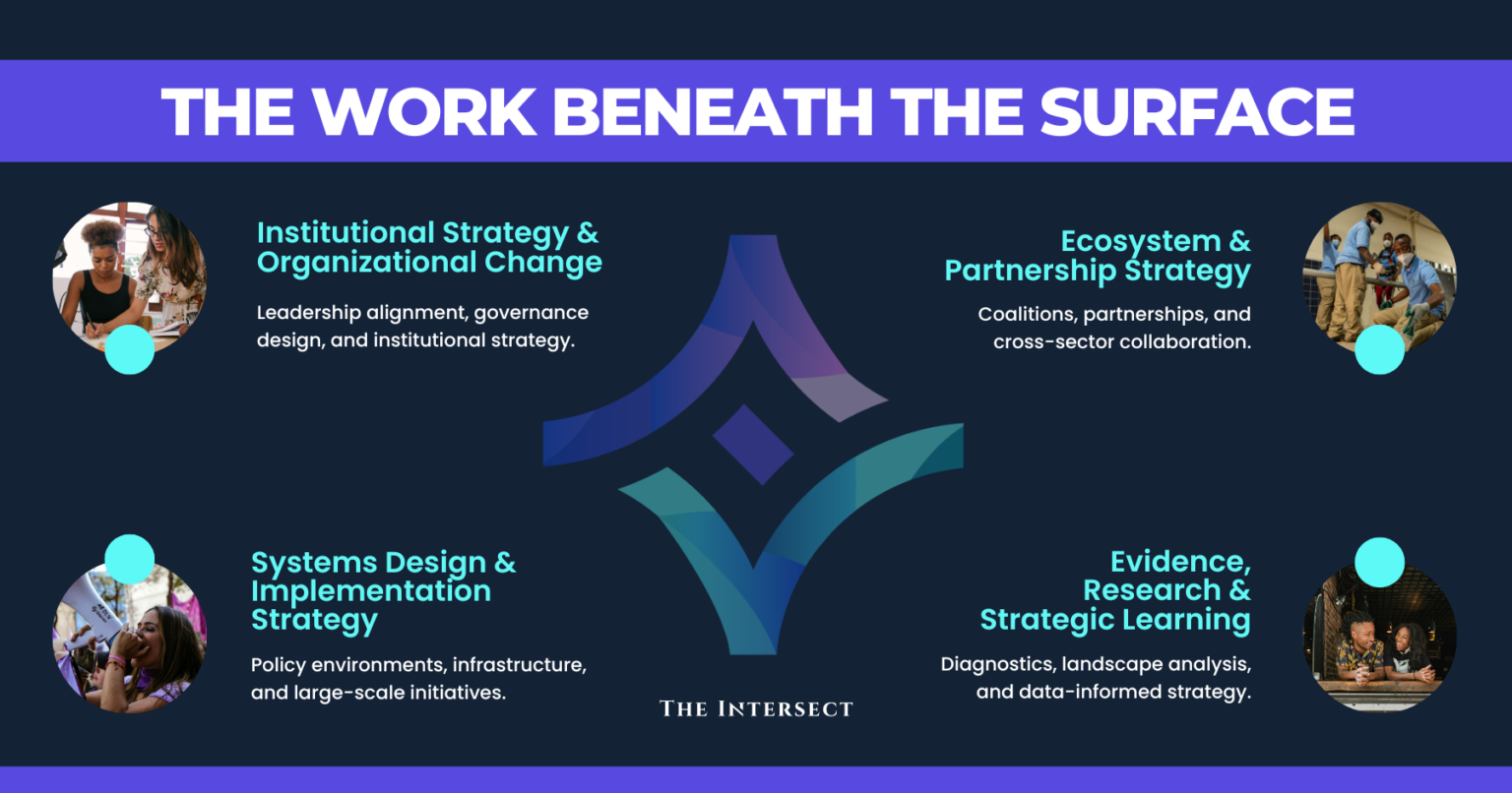
This is one reason our work increasingly focuses on Institutional Strategy & Organizational Change alongside Systems Design & Implementation Strategy.
Looking Beyond the Immediate Cycle
Today, institutions are navigating extraordinary complexity.
Economic uncertainty, political shifts, changing public expectations, and resource constraints place increasing pressure on organizations to respond quickly.
Yet one of the most important questions leaders can ask is not: “How do we respond?”
It is: “What will allow this work to hold over time?”
The question shifts the focus from short-term action to long-term capacity. It asks leaders to build structures, relationships, governance, and accountability needed to sustain progress through leadership transitions, funding shifts, and changing priorities.
Change is inevitable. Disruption will occur. But whether the conditions exist for progress to continue when it does is the question.
Because lasting impact is the result of intentionally designing the conditions that allow high-level work to endure.